
HoloLens in AR marketing and product presentations
Product presentation with augmented reality initially sounds like something out of a science fiction film. To advertise products or services, the customer can view them three-dimensionally embedded in a real environment. Not only that: it is possible to freely place the objects, walk around them, adjust their colours and other properties as desired and even interact with them. This is made possible by AR data glasses like the Hololens.
Promoting purchasing decisions with AR and Hololens

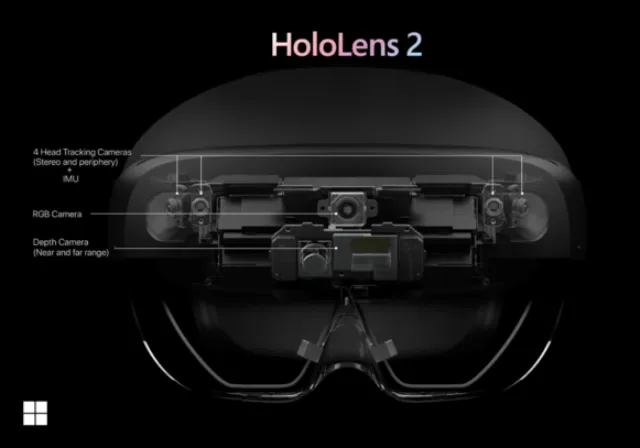
Augmented reality (AR) is often confused with virtual reality (VR). While VR solutions involve wearing glasses that completely block out reality and immerse the user in a purely virtually generated environment, AR creates the possibility of so-called mixed reality, i.e. the coupling of digital projections and a real environment.
The Hololens are AR data glasses that are in principle normally transparent, but which superimpose the virtual content on the actual environment. Such systems have long been able to do more than just display information. The projection of 3D-generated holograms in real time is one of the strengths of Hololens. What initially sounds like a toy and was in fact originally developed for the gaming industry has the potential to redefine entire industries in the marketing and sale of products.
Anyone who not only looks at products in a catalogue or on a flat screen, but can experience them in the desired environment in their own home or "in the wild" at the respective place of use, gets a much more comprehensive overall impression of the product. But how can purchasing decisions be promoted with AR systems like the Hololens 2 from Microsoft?
Use AR to display product information

Digital storytelling is already an important field in marketing today. With the possibilities of the internet and modern technology, products are presented in a completely different way than they were a few years ago. Product presentation with augmented reality goes one step further. Because here the customer finds all the information combined in an intelligent and interactive context.
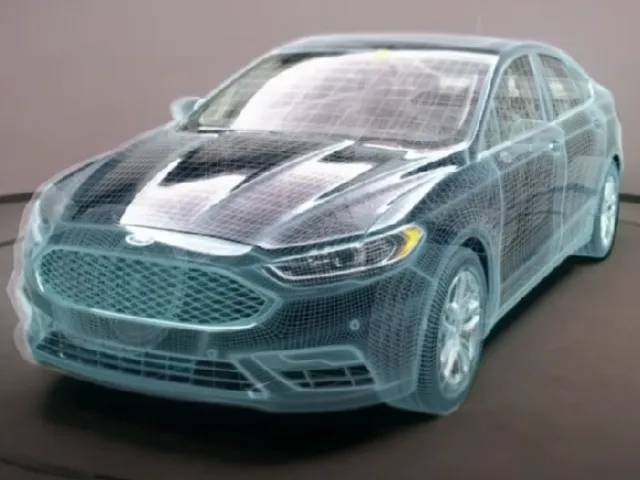
An example: If you are interested in buying a new car, in future the dealer will no longer have to have all the equipment variants of the vehicle in the showroom or refer to brochures. All important features such as optional extras and information on technology, function and surcharges can be realised completely via an AR app for product presentation with the Hololens. You want the car to be a different colour? No problem. With compatible 3D models for Google AR, the Hololens can display all features in real time thanks to powerful processors and image processing technology. The dealer has to explain less without sacrificing the personal experience of the product presentation.
In fact, the salesperson would not even need to be on site because advice and other content can be interactively integrated into the presentation. Companies that use AR to convey product information have great advantages over the competition in almost all industries.
AR marketing and product presentation of the future

AR marketing will reach completely new dimensions with data glasses like the Hololens. Target group-optimised customer approaches in scenarios that can be adapted at will are another example of the possibilities of AR in marketing. All problems and solutions to problems can be individually adapted to the respective customer and varied in real time during the presentation.
With an AR app for 3D product presentation, the customer advisor has the opportunity to demonstrate problem solutions directly in three dimensions instead of just explaining them verbosely. Images and videos for illustration, as used on today's internet, on the other hand, cannot be customised. The experience of a sales fair with the possibility of real-life experience of products can in principle be recreated anywhere with AR apps for product presentation and a Hololens - without crowds or overburdened sales staff. Purchase decisions are thus accelerated and at the same time based on sound product knowledge - something that customers particularly appreciate.
The Hololens is not intended to replace the real product experience, but rather serves as a kind of bridge between reality and the pure virtuality of previous online presentations. The well-known example of the furniture store is particularly well suited to understanding the advantages of Hololens in marketing. Because the presentation of bulky furniture in the real environment of one's own four walls is fundamentally more convincing to customers than going to an anonymous furniture store.
Instead of having to imagine how the new wardrobe will look in the living room with imprecise measuring methods and a flat 2D plan in hand, this can be checked directly on site thanks to online shop 3D product presentation. The probability of signing a contract is likely to be much higher for such companies.
Conclusion: Hololens can revolutionise marketing through AR product display
While augmented reality for product development, design and project management has long become standard in some industries, AR marketing is still in its infancy. Not many companies are already using solutions based on the use of data glasses like the Hololens. But the same could be said about online shops on the internet at the end of the 90s.
Today, we know that early and professional adaptation of new technologies means an edge over the competition. Using AR in digital marketing is more or less a logical consequence of the further development of modern technology. For both customers and providers, many new options arise that bring advantages for both sides. It should therefore be no coincidence that the big players on the market are particularly interested in Hololens and product presentation with augmented reality.